Copy Bench method
Abstract
Copy Bench is a benchmark for video-conditioned webpage recreation. Each system receives a 4 to 8 second screen recording of an animated web component and produces a single HTML file, first in a single pass and then with iterative refinement under render feedback. Outputs are executed under the reference's fixed interaction script and scored against an analytic rubric by a reference-based panel of two LLM judges from disjoint model families. Scores are aggregated deterministically from 26 criteria across five dimensions.
We evaluate 16 systems on 50 tasks, 1,600 outputs in total. We report intra-rater reliability (r = 0.97), inter-judge correlation (r = 0.89, mean absolute difference 10.0 points) and alignment with human scores on 249 outputs (r = 0.84), and we validate the judge with oracle and planted-defect controls. 37 of the 50 tasks form a private held-out set.
1 Task
Given a reference recording V of a web page and the interaction script S that drove the page while it was recorded, a system must produce one self-contained HTML file C. Rendering C in the same browser under the same script yields a second recording V′. The task is to make V′ match V in both static appearance and animation.
This is the task WebVR [1] calls video-conditioned webpage recreation and AnimWeb-Bench [2] calls animated webpage code generation from videos. It differs from screenshot-to-code [4] in that the reference carries timing, easing and response to input, none of which a still frame contains.
Fidelity is the only target. The reference is never improved on: a copy that looks better than the original and differs from it is scored as a worse copy.
2 Dataset
Composition. The benchmark has 50 tasks. Each is one component rendered at 1280×800 and recorded at 25 fps for 4 to 8 seconds from the load event. 30 come from the 21st.dev component catalog and 20 are open-source demos. 30 tasks animate with no input (timelines and shader loops). The other 20 are driven by a scripted pointer, scroll or keyboard sequence that is replayed identically for the reference and for every copy.
| Category | Tasks |
|---|---|
| Pages and scroll | 7 |
| 2D animation | 12 |
| Games and physics | 7 |
| Shaders | 14 |
| 3D and WebGL | 10 |
Selection. We started from 98 candidates and kept 50. A candidate was dropped when it did not discriminate between systems, when its rendering was not repeatable across loads, when it duplicated another task, or when it failed contamination screening.
Contamination screening. Frontier models can reproduce a well-known demo from memory, which would measure recall and not vision. We therefore ran a memorization probe: stills of each candidate were shown to four models (Claude Opus 5.5, Claude Sonnet 5.5, Grok 4.7, Muse Wonder 1.0) with a fixed prompt asking them to name the source. Candidates that the probe models identified by name or URL were removed. Among them: 2048, a Magic UI list and an Aceternity card, each recognized by at least three models.
Held-out split. 13 tasks are public and 37 are private. The private set is never distributed, so a system cannot be tuned on it. A private held-out set is the standard guard against contamination [12, 13]. The leaderboard is computed on all 50, and the public 13 serve as a reproducible development set.
3 Systems
Each model runs inside its maker's own coding agent at that agent's published version. The unit under test is therefore the system, model plus harness, and not the model in isolation. We chose this because it is how these models are used for front-end work, and because a single shared harness would handicap every model it was not tuned for.
| Model | Harness | Effort |
|---|---|---|
| GPT-6.2 Astra | Codex 0.167.2 | medium |
| GPT-6.2 Sol | Codex 0.167.2 | medium |
| GPT-6 Astra | Codex 0.167.2 | medium |
| GPT-6.1 Sol | Codex 0.167.2 | medium |
| Claude Fable 5.2 | Claude Code 2.1.323 | medium |
| Gemini 4 Carbon | Gemini CLI 0.68.0 | high |
| GPT-6 Sol | Codex 0.167.2 | medium |
| Claude Opus 5.5 | Claude Code 2.1.323 | medium |
| Qwen 4 Max | Qwen Code 0.27.2 | default |
| Muse Wonder 1.0 | Muse Code 1.4.18 | medium |
| Qwen 3.8 Max Prime | Qwen Code 0.27.2 | default |
| Kimi K3.1 Pro | Kimi Code 2.6.0 | default |
| MiniMax M3 | MiniMax Code 0.7.7 | default |
| Grok 4.7 | Grok Build 1.0.77 | medium |
| Claude Sonnet 5.5 | Claude Code 2.1.323 | medium |
| MiMo V2.6 Pro | MiMo 0.1.16 | default |
Before the run, every harness passed an image probe (a random word drawn only into a PNG, which the model must read back) and a session-resume check. A harness that cannot show images to its model was excluded, since the task requires vision.
4 Protocol
Each task is one sandbox (2 CPUs, 4 GB) and two consecutive steps in the same agent session.
Step 1, single-pass generation (30 min). The system gets the recording, the interaction script and a tool that extracts frames from the recording at any time or rate. There is no browser in the sandbox, so the system cannot render its own output. The browser binary is present in the image but encrypted, and the key is withheld until step 2.
Step 2, refinement under render feedback (20 min). The key is delivered and a headless browser is unlocked. In the same session, the system can now open its own page, record it, compare it with the reference frames and edit the file. This is the closed loop of execution, visual inspection and repair studied in [2, 5]. The original page is never served. The system only has the recording.
Isolation. During both steps, network egress is an allowlist: the model APIs and four library CDNs. Most originals are public, and open internet would let a system download the source it is supposed to reconstruct. The system never sees a score or the judge.
Budget. A run that hits the time limit still counts. Whatever file exists at the limit is graded. 155 of 1,600 steps hit the limit. Each system ran each task once.
5 Execution and capture
Every output is executed in headless Chromium with the same viewport, device scale factor, color scheme, locale and timezone as the reference, and the reference's interaction script is replayed on the same timeline. Time zero is the page's load event. All published scores come from references and copies captured on one machine.
Two real-time captures of the same page can be a frame or two apart. Before comparison, the copy's recording may shift by at most ±120 ms, in 40 ms steps, to the offset that best matches the reference. The cap is deliberately small so that it absorbs capture jitter and cannot excuse an animation that starts late.
6 Scoring
Judge input. The judge never sees code. For each output it receives image sheets with the reference on the left, the copy on the right and a difference map between them: the settled page, the page at four timestamps, and one timeline sheet holding every frame in order. The difference map stays dark below 7 of 255 in intensity and below 3 px in width, which is what capture noise leaves.
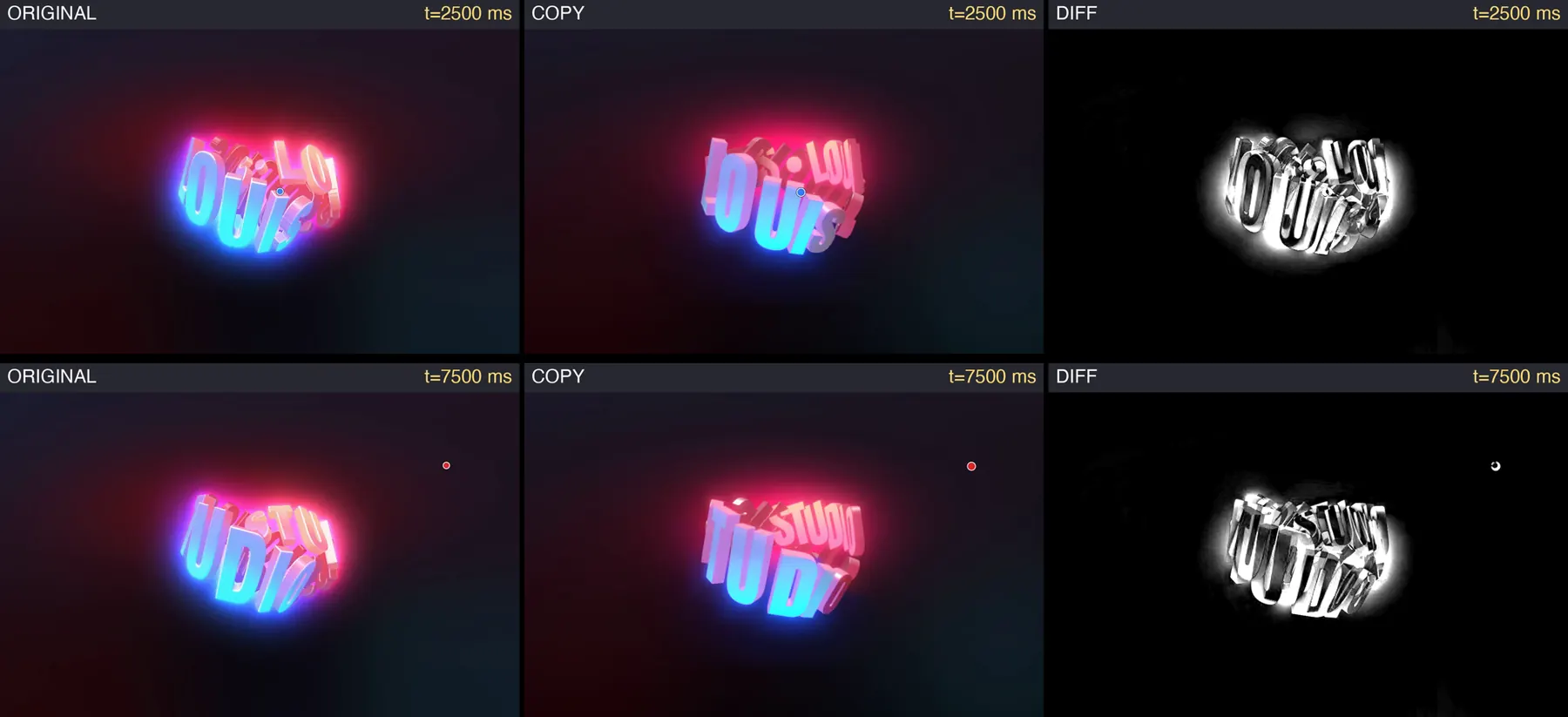
Rubric. Holistic ratings on a Likert scale are unstable across LLM judges [7]. We instead score against an analytic rubric: fidelity is decomposed into 26 fixed criteria in five dimensions, and each criterion is rated separately. This follows rubric-based and checklist-based evaluation [1, 7, 8]. Where those methods rate a criterion as met or unmet, each of ours takes one of three severity levels: same, minor (visible only in a side-by-side comparison) or major (a user would notice it without the reference). A criterion can be not applicable when the reference has nothing it refers to. For every rating other than same, the judge must cite the sheet and timestamp where the difference shows.
| Dimension | Weight | Criteria |
|---|---|---|
| Content | 25% | all text present, same words; all elements present; same counts of repeated things; nothing extra added |
| Layout | 25% | same blocks in the same order; positions within ~5% of the viewport; sizes within ~10%; same alignment and overlap; nothing cut off or overflowing |
| Motion | 20% | the same things move, the same things stay still; same kind of motion; same path and distance; start time and speed within ~20%; same stagger, easing and loop; same reaction to mouse and scroll; canvas and shader content: same structure over time |
| Color | 15% | same background; same accents; same text and surface colors; same gradients; same light/dark relations and shadows |
| Typography | 15% | same family class; same weight; size within ~10%; same case and letter spacing; same line breaks |
Deterministic aggregation. The judge only rates criteria. Code computes every number. A dimension scores max(0, 100 − 15·minors − 40·majors) over its applicable criteria, and the output score is the weighted mean of the dimensions with the weights of Table 3. The two penalties were fixed on synthetic calibration pairs (Section 8) before any system output was graded.
Adjudication. A major costs 40 points, so it is not accepted on one reading. Any grading that contains a major is repeated. If the two readings disagree on a major, a third decides, criterion by criterion.
Judge panel. A single judge carries the bias of its model family [9, 10]. We use a panel of two from different labs, GPT-6.1 Sol and Claude Opus 5.5, and average them. GPT-6.1 Sol grades each output three times and contributes the median. Claude Opus 5.5 grades once. The published score of an output is the mean of the two.
7 Outcome validity
A benchmark is only valid if a high score cannot be reached without doing the task [12]. Three outcomes score zero regardless of how the output looks:
- Copied code. An iframe or embed of the original, the original's address, or more than 25% of the code matching the original's source.
- Replayed pixels. A video element, a set of raster frames swapped on a timer, or more than 150 KB of inlined binary data. Embedded fonts are exempt.
- No file. The system left no output.
Across 1,600 outputs, 6 were zeroed for copied code, none for replayed pixels and 31 for a missing file. Two outputs failed twice for infrastructure reasons and are excluded, which leaves 1,598 scored.
8 Validation of the judge
An LLM judge must be validated before its scores are reported [6, 11]. We ran five validations.
- 0.97
- Same judge, graded twice r
- 0.89
- The two judges agree r
- 0.84
- Judges match a human r, 249 copies
- +3.8
- GPT judge on GPT copies points of bias
Controls. On seven tasks, the original itself was captured a second time and graded as if it were a copy. The GPT judge returned 100 on all seven and the Claude judge between 94 and 100. An unrelated page scores 0. These two results fix the ceiling and the floor of the scale.
Planted defects. Following perturbation-based meta-evaluation [11], we built 13 copies of one page that each differ from it in a single known way. All 13 score below the identical copy, and a missing element costs far more than a shifted one.
| Planted defect | Score |
|---|---|
| Heading weight 700 to 500 | 97.8 |
| Card background 4% lighter | 95.5 to 97.8 |
| Card 4 px lower | 96.2 |
| Card 8 px lower | 96.2 |
| Easing changed to linear | 94.0 |
| Loop 1.15× slower | 94.0 |
| Accent color changed | 94.0 |
| 1 px outline added | 91.0 |
| 1 px divider removed | 90.0 |
| Moving element recolored | 94.0 |
| Animation starts late | 89.0 to 92.0 |
| Animation 5× slower | 84.0 |
| Button removed | 52.0 to 55.0 |
Intra-rater reliability. The same judge grading the same output twice: r = 0.97 for GPT-6.1 Sol (n = 1,499, mean absolute difference 4.7 points) and r = 0.97 for Claude Opus 5.5 (n = 64, 5.2 points).
Inter-judge reliability. Over all 1,598 scored outputs, the two judges correlate at r = 0.89 (Spearman ρ = 0.89). Correlation measures whether two raters rank alike, not whether they give the same number, so we also report agreement: an intraclass correlation of 0.89 (two-way, absolute agreement, single rater) and a mean absolute difference of 10.0 points. With the 55 outputs both judges score 0 removed, r = 0.87.
Human alignment. One annotator scored 249 outputs from 13 systems on 23 tasks on the same 0 to 100 scale. The panel mean correlates with the human scores at r = 0.84 (ρ = 0.83), with a mean absolute difference of 9.3 points. The panel scores 2.6 points higher than the annotator on average.
Self-preference. LLM judges tend to favor outputs of their own family [10]. We measure it as the difference between the two judges on the same outputs. On outputs of OpenAI systems, the GPT judge scores 3.8 points above the Claude judge (n = 500). On Anthropic systems it scores 0.9 below (n = 300), and on all others 0.5 above (n = 798). Averaging the panel halves the effect on the published score but does not remove it.
| Comparison | n | r | MAD |
|---|---|---|---|
| GPT-6.1 Sol, grade 1 vs grade 2 | 1,499 | 0.97 | 4.7 |
| Claude Opus 5.5, grade 1 vs grade 2 | 64 | 0.97 | 5.2 |
| GPT-6.1 Sol vs Claude Opus 5.5 | 1,598 | 0.89 | 10.0 |
| Panel mean vs human annotator | 249 | 0.84 | 9.3 |
9 Uncertainty
Without confidence intervals, noise can be read as rank [13, 14]. For each system we compute a 95% confidence interval by bootstrap over tasks (2,000 resamples). The half-width runs from 2 points for the strongest systems to 8 for the weakest. The intervals are computed on the GPT judge's scores.
The gain from step 1 to step 2 is a paired difference on the same tasks. Its interval excludes zero for 15 of the 16 systems.
Each system ran each task once, so the intervals reflect variation across tasks and not across reruns. In pilot reruns, the score of a single task moved by 10 to 19 points. Differences on one task should not be read. Differences between systems whose intervals overlap should be read as ties.
10 Limitations
- One run per cell. We do not resample, so we cannot separate a system's run-to-run variance from task difficulty.
- One annotator who was not blind. The human scores come from a single person who saw the GPT judge's score before giving their own. This biases the human check toward the judge, and we report no human inter-annotator agreement.
- Per-output scores are coarse. The two judges differ by 10 points on an average output. Scores are meaningful in aggregate over tasks, less so for one output.
- The panel is uneven. One judge contributes a median of three gradings and the other a single grading.
- We compare systems. Harnesses differ in tools, prompts and reasoning settings (Table 2). A difference between two rows is not attributable to the model alone.
- Small offsets are not separated. The judge gives a 4 px and an 8 px displacement the same score. The scale has no resolution below the rubric's 5% position tolerance.
- Residual self-preference. About 2 points of family bias remain in the panel mean for OpenAI systems.
- Software rendering in the public set. References were recorded with GPU rendering. A sandbox that draws WebGL in software can render a correct copy slightly differently. Published scores captured both sides on one machine and are not affected.
11 Relation to prior work
WebVR [1] introduced the video-conditioned task and a rubric judge on 175 synthesized pages. AnimWeb-Bench [2] and Animation2Code [3] score motion with component and point trackers on real pages and isolated animations. Copy Bench differs in three ways.
First, the content. 24 of our 50 tasks are shaders or WebGL scenes, and more draw particles or games to a canvas. A tracker that follows DOM components has nothing to follow there, which is why we score from rendered pixels with a judge.
Second, the protocol. The same session produces a single-pass output and then a refined one, so the value of render feedback is measured as a paired difference within a run.
Third, the unit. We evaluate agentic systems in their native harness under a time budget, where prior work mostly evaluates a model through a single API call.
12 Data and code
The 13 public tasks, the in-sandbox grader and the rubric are on GitHub and run on Harbor as 21st/copy-bench. Every output, next to its reference and with both judges' scores, is on the results page.
References
- [1]WebVR: Benchmarking Multimodal LLMs for WebPage Recreation from Videos via Human-Aligned Visual Rubrics. 2026. arXiv:2603.13391
- [2]Zhang et al. AnimWeb-Bench: Benchmarking Animated Webpage Code Generation from Videos. 2026. arXiv:2611.09769
- [3]Ji et al. Animation2Code: Evaluating Temporal Visual Reasoning in Video-to-Code Generation. 2026. arXiv:2606.28593
- [4]Si et al. Design2Code: Benchmarking Multimodal Code Generation for Automated Front-End Engineering. 2024. arXiv:2403.03163
- [5]UI2Code^N: UI-to-Code Generation as Interactive Visual Optimization. 2025. arXiv:2511.08195
- [6]Li et al. LLMs-as-Judges: A Comprehensive Survey on LLM-based Evaluation Methods. 2024. arXiv:2412.05579
- [7]Lee et al. CheckEval: A Reliable LLM-as-a-Judge Framework for Evaluating Text Generation Using Checklists. EMNLP 2025. ACL Anthology
- [8]Cook et al. TICKing All the Boxes: Generated Checklists Improve LLM Evaluation and Generation. 2024. arXiv:2410.03608
- [9]Verga et al. Replacing Judges with Juries: Evaluating LLM Generations with a Panel of Diverse Models. 2024. arXiv:2404.18796
- [10]Panickssery et al. LLM Evaluators Recognize and Favor Their Own Generations. 2024. arXiv:2404.13076
- [11]Doddapaneni et al. Finding Blind Spots in Evaluator LLMs with Interpretable Checklists. EMNLP 2024. ACL Anthology
- [12]Zhu et al. Establishing Best Practices for Building Rigorous Agentic Benchmarks. 2025. arXiv:2507.02825
- [13]Bean et al. Measuring what Matters: Construct Validity in Large Language Model Benchmarks. NeurIPS 2025. arXiv:2511.04703
- [14]Miller. Adding Error Bars to Evals: A Statistical Approach to Language Model Evaluations. 2024. arXiv:2411.00640